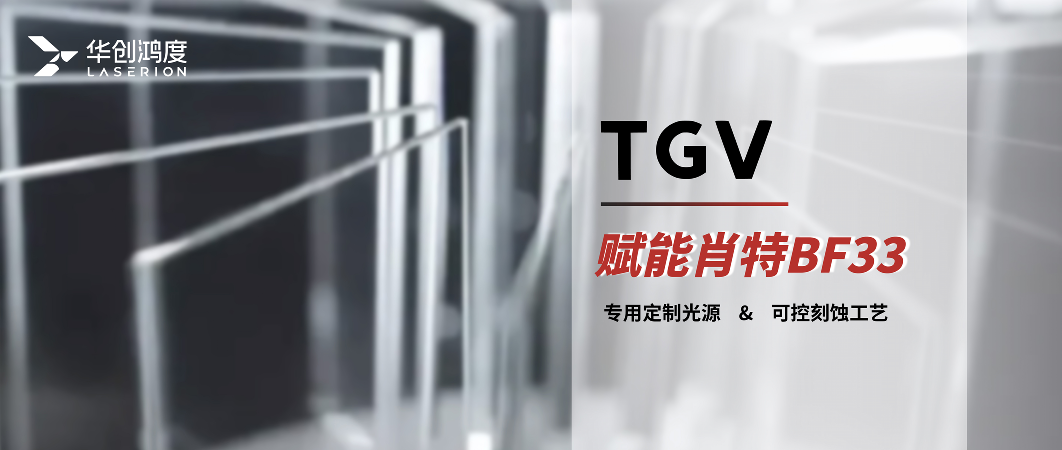
In“How to break the TGV production barrier with lasers?In the article”The Key to Break the Glass Core Era Technology”,we pointed out “high-precision drilling is the basis of the success or failure of the subsequent process”.This challenge is particularly evident in the use of high-performance borosilicate glass such as Schott BF33.
This article will focus on the laser-induced etching technology used by Huachuang HongduDescribe how we fully combine the material characteristics of BF33 to achieve low taper, high verticality and smooth side wall glass through hole machining,laying a solid foundation for subsequent high-quality metallization interconnection.
Schott BF33 is a kind of high borosilicate glass made by microfloat process.With uniform texture,smooth surface and excellent optical properties and so on,it is one of the ideal substrate materials for TGV applications.The micro-float process ensures that its internal composition and stress distribution are highly even,providing a stable basis for laser processing;The excellent chemical stability ensures the controllability of the etching process and the quality of the sidewall,while the matching thermal expansion coefficient of silicon helps to reduce thermal stress and improve the overall reliability of the device.
These properties make BF33 an excellent substrate for TGV technology, but its final application is still highly dependent on the technical accuracy of the pore-forming process.
Huachuang Hongdu TGV hole-forming technology takes”stable and controllable”as the core goal,By“custom laser source+self-controlled etching process”matching the material characteristics of BF33,achieving high consistency and high verticality through-hole processing effect.
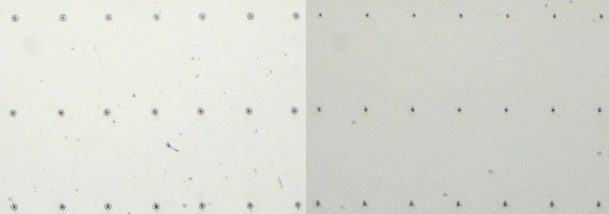
△ Laser Induced – Front of Glass (left), Back of Glass (right)(Huachuang Hongdu Microscopic Measurements)
By optimizing laser parameters such as beam quality, pulse width and scanning path, the technology can form a uniform and accurate modified trajectory。Combined with the self-etching recipe and dynamic control technology, the vertical etching selectivity was significantly improved, thus effectively inhibiting the lateral etching while realizing fast through-holes,and producing nearly vertical through-holes with a taper of only 0-2°.
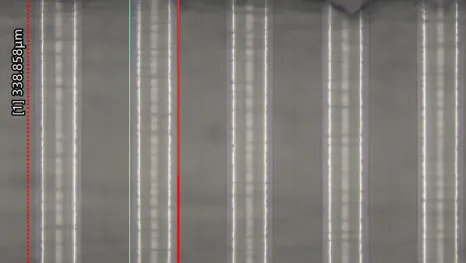
△ The Glass Carved End Surface (Huachuang Hongdu Measurement Microscopic Photo)
Based on this highly vertical porous structure,coupled with the excellent properties of smooth sidewall morphology and microcracking,Huachuang Hongdu TGV technology not only performs excellent in the depth-diameter ratio and physical integrity,but also significantly improves the consistency and good rate of the product in microelectronic packaging and integration applications,completely meeting the strict requirements for glass porous mass manufacturing in high-end fields such as 5G and wafer-grade packaging.
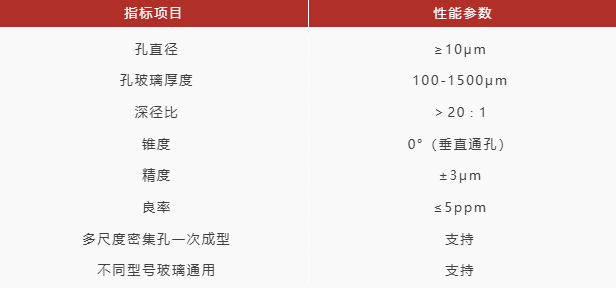
Based on the above technology path,Huachuang Hongdu has shown excellent TGV processing capability on Schott BF33 substrate,with the following specific technical indicators:
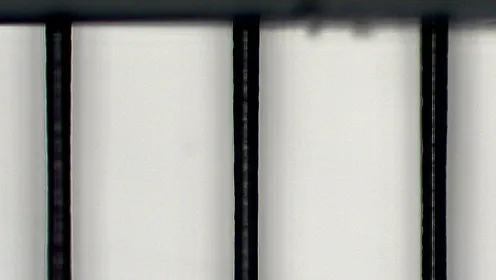
△ The Carved End Surface (Huachuang Hongdu Grain Measurement Microscopic Photo)
Compared to traditional drilling processes,the BF33-based laser-induced etching through holes effectively avoids microcracks,fragmentation and thermal stress problems,demonstrating superior structural integrity and process consistency.
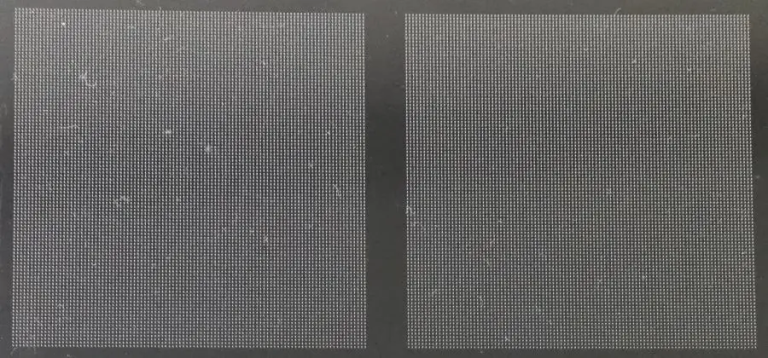
△ TGV Effect Display on SCHOTT BF33 (Huachuang Hongdu photos)
The outstanding properties of Schott BF33 glass are complemented by Huachuang Hongdu’s precision processing technology,converting material potential into stable and reliable processing results,providing an ideal glass-based interconnection solution for high-density 3D integration and advanced packaging.
Glass substrate types are diverse,and different materials correspond to different process challenges.Next,we will explore how Huahua Hongdu’s TGV perforation technology is adapted to companies such as Corning(Corning ).Diverse substrates such as glass demonstrate process compatibility and performance advantages.Please continue to pay attention.