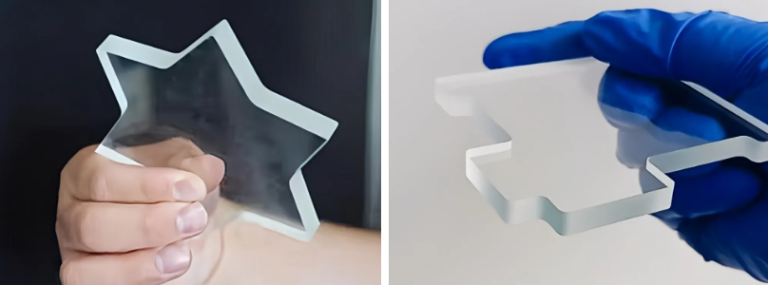
△ Showcase of Glass Materials
In many traditional fields such as construction,home furnishing industrial equipment,etc.,ultra-thick glass (usually refers to thickness≥15mm) is increasingly widely used with its rugged,transparent and beautiful characteristics.However,when facing ultra-thick glass,traditional processing methods often face problems such as difficulty in cutting,low efficiency,high environmental cost and difficulty in securing edge quality.
Huachuang Hongdu uses a high-energy infrared skin-second laser to achieve a single cut of 18.5mm (non-maximum cutable thickness) of glass,with a flat incision without fragmentation,providing a new and efficient solution for thick glass processing.
Before laser cutting technology was widely used,glass processing was mainly dependent on water jet,CNC or diamond wheel.These traditional methods have obvious shortcomings when dealing with ultra-thick glass:
The processing speed is slow,the process is tedious,and it is easy to cause the cut surface to be rough and the edges to collapse.
The processing process can easily cause micro cracks,affect the appearance and weaken the strength of the structure,making it difficult to meet the strict requirements of high-end equipment and precision instruments.
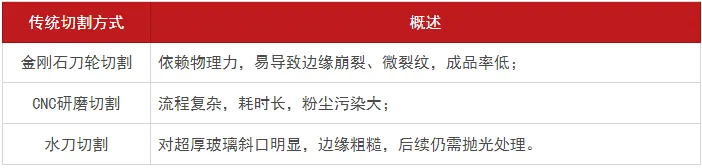
△Traditional processing methods often fail to combine efficiency and quality
In addition,traditional cutting often requires additional cleaning or grinding processes,increasing the number of process steps and resource consumption.
Laser technology through ultra-short pulse and non-contact processing characteristics,can achieve high efficiency,low damage glass cutting,and has multiple comprehensive advantages.
The picosecond ultra-fast laser has ultra-high peak power and injects energy into the ultra-short pulse(10⁻¹² seconds )in a very short time to avoid thermal diffusion and achieve “cold processing “.It can effectively work on the inside of the ultra-thick glass and achieve efficient separation.
The laser beam is precisely focused,and along the predetermined path forms a uniform metamorphosis layer inside the glass,achieving a neat separation,and the cut surface is smooth and vertical.
①Non-contact cutting effectively avoids microcracking and debris flaking,basically without residual stress, and the edge strength is significantly improved;
②The cutting speed is fast,the edges are straight and vertical,the internal damage is extremely low,and there is no need for subsequent cleaning or grinding;
③There is no need to configure equipment such as grinders,and the overall investment and operating cost are more advantageous;
④Prominently environmentally friendly,simple process, and reduced after-treatment.
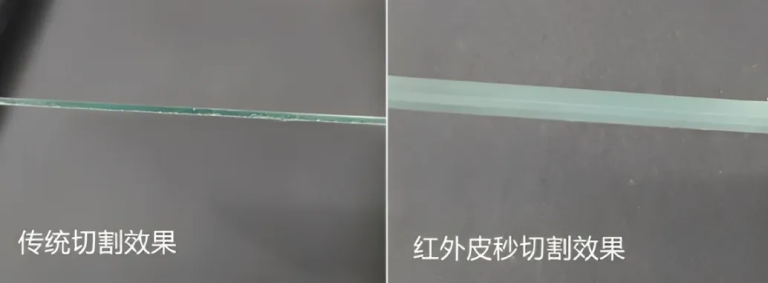
△Compare the Effect of Traditional Cutting with Laser Cutting
We believe that with the continuous development and application of advanced technologies such as picosecond lasers,glass cutting will usher in more breakthroughs.
Faced with the ultra-thick glass cutting task that is difficult for traditional processes,Huachuang Hongdu used a large-energy infrared skin-second laser to conduct cutting real-time,successfully achieved a one-size-fits-all cutting of 18.5mm glass, truly achieving “thicker, faster and stronger.”
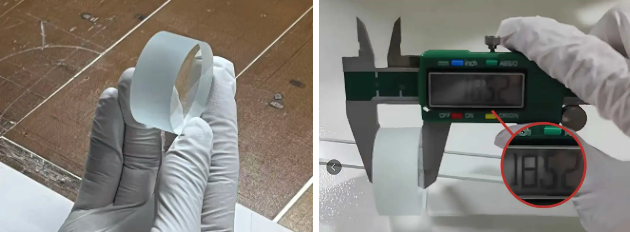
△Laser Cutting 18.52mm Ultra-thick Glass Display
This test completes one knife cutting of 18.5mm ultra-thick glass,without multiple penetrations,and the maximum thickness can be supported up to 20mm.
The pulse energy is up to 3.5mJ,With higher repetition frequency,the cutting speed is significantly improved.
On the premise of ensuring the quality of the incision,the cutting speed reaches the applicable standard for mass production.
The observations show that the incision is smooth and smooth,basically without breaking edges and microcracks,and meets the requirements of high-standard applications.
The process uses a high-energy infrared skin-second laser with a high energy beam focused precisely on the glass surface,forming a starting crack by thermal stress guided rather than melting,ensuring that the cut is flat and debris-free.After the cutting is completed,the automatic detachment is achieved by heating the CO2 laser.
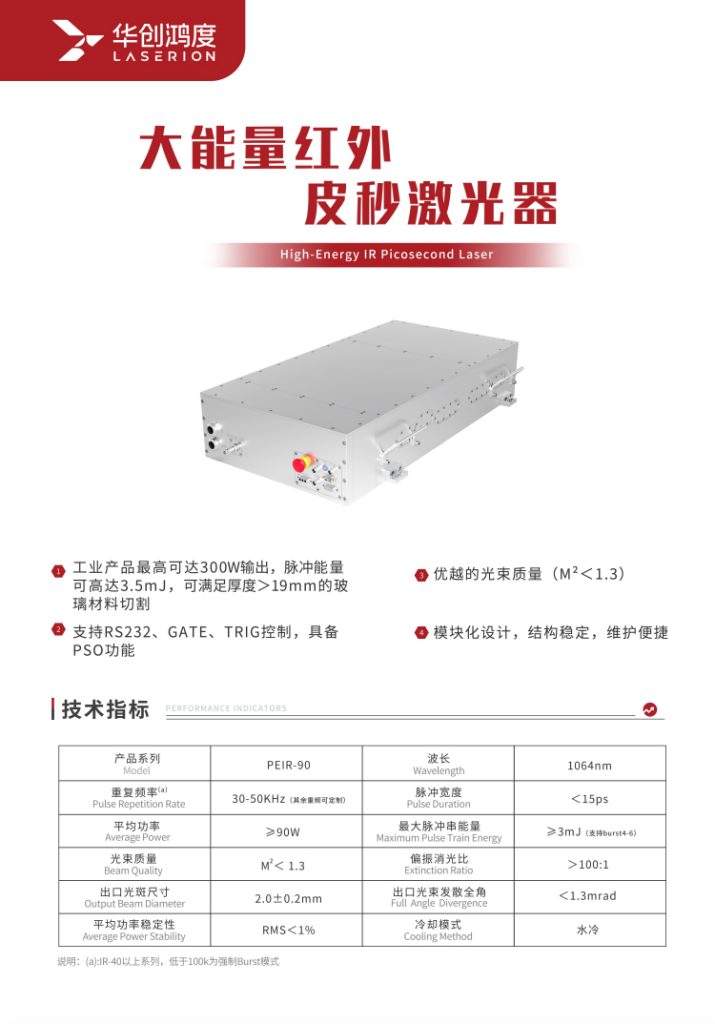
△ Product Specifications for High-energy Infrared Skin-second Lasers
This time,the 18.5mm ( non-maximum cutting thickness ) ultra-thick glass cutting record,not only shows our technical strength in laser processing thick glass,but also provides new possibilities for ultra-thick glass applications in the fields of architecture and industrial equipment.
In the coming installments of the “Process Notes” series,we will continue to explore the limitless possibilities of laser processing on a variety of different materials,and you are welcome to stay tuned.