Recently,the High Energy Solid State Laser Technology Research Group of the Laser Center of the Institute of Physics and Chemistry,Chinese Academy of Sciences,has proposed and verified A New Scheme of Ultrafast Laser Parametric Frequency Conversion – Periodic Array Mode Self-Reproducing Optical Parametric Frequency Conversion Technology , the related research results are published in High-energy,3 ps,1.5 μm optical parametric conversion based on an array of periodic KTA crystalsPublished in the Optics Letters journal (volume 51, No.1.Page 237,2026).
Prior to this,the two sides “laser spectrum beam” scheme has successfully cooperated.Based on this, Anhui Huachuang Hongdu Optoelectronic Technology Co., Ltd.(hereinafter referred to as “Huachuang Hongdu”) once again teamed up with the Institute of Physics and Chemistry to provide core light source and system integration support for this new technology,and jointly completed the experimental verification work.

The new technology successfully addresses the bottlenecks faced by traditional SPOPO methods in combining high energy,ultrashort pulses and compact structures, opening a new path for the development of miniaturized, high-performance ultrafast scalar laser sources.
Industry Bottlenecks
Ultrafast lasers with a pulse width of picoseconds (1 picosecond = 10⁻¹² seconds) are the core tools for precision “cold processing,” biomedical imaging,optical communication and other cutting-edge fields.Among them, the 1.5 μm waveband light source is considered an ideal choice due to its “human eye safety” and low fiber loss characteristics.However,the industry has long faced a core contradiction:how to simultaneously achieve high pulse energy,high beam quality and extremely short pulse width in a very compact volume?
Current mainstream technology paths have limitations:
Innovative Programmes
In response to the above industry pain points, the research group of the Institute of Physics and Chemistry creatively proposed the “periodic array mode self-replication” new idea.The core of the scheme is to abandon the traditional complex long resonator and adopt a compact periodic array composed of many non-linear crystals arranged in a precise way.
The working principle can be summarized as follows:the pump light and the resulting signal light travel multiple times in this series of crystals.Through precise optical design, signal light achieves “mode self-reproduction”every time it passes through the crystal and maintains optimal coupling with pump light at all times.This process skillfully simulates the mode screening and energy amplification function of a resonator several meters long at a short distance of tens of centimeters,but gets rid of the limitation of SPOPO on the length of the cavity.The efficient frequency transition of a “self-synchronized pump” was achieved.
From an innovative theory to a viable solution, engineering validation is a crucial step. In this work, the research team of the Institute of Physics and Chemistry collaborated closely with Huajian HRD to jointly complete the principle verification.
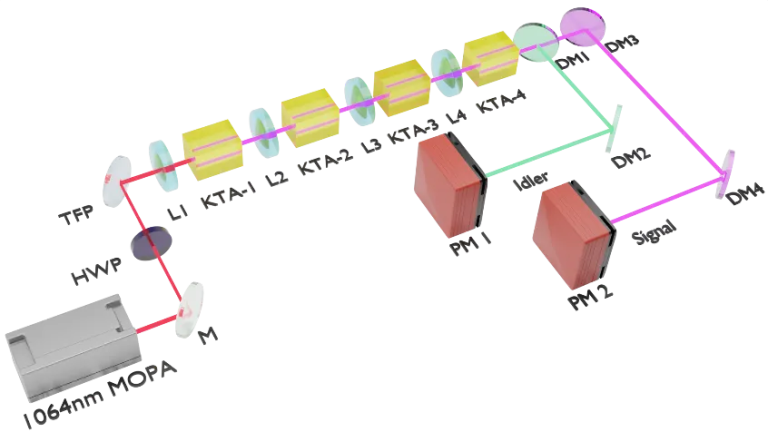
△Figure of the Experimental Device
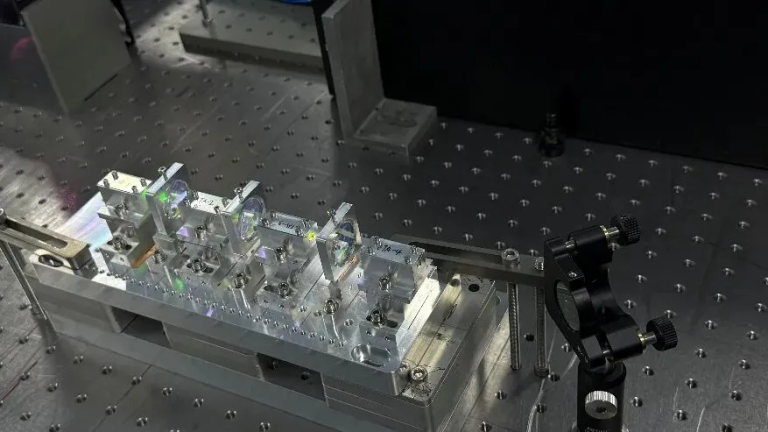
△ Physical Diagram of the Periodic Crystal Array Frequency Transition Device
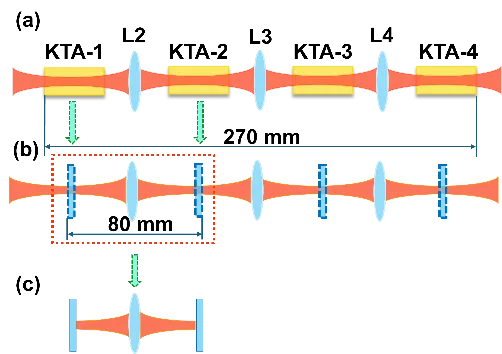
△ The Principle of the Periodic Crystal Array Frequency Transition Device is Shown:
(a) Two-dimensional Maps;(b) Simplified Models;(c) Equivalent Single Resonator
The Value of Scholarship and Research
The core academic contribution of this work is that it successfully challenges the traditional perception that “high performance” and “compactness” have long been difficult to reconcile in the field of ultrafast lasers.
Compared with all kinds of picosecond optical parametric systems reported in the world , this work for the first time simultaneously achieved high energy of the order of μJ and short pulse width of the order of several ps at MHz repetition rate in a very compact size of tens of centimetres.It not only retains the advantages of good beam quality and high spectral purity of traditional SPOPO and compactness of OPG/OPA,but also breaks through the performance bottleneck of existing technology,providing a promising new technology path for ultrafast laser field.
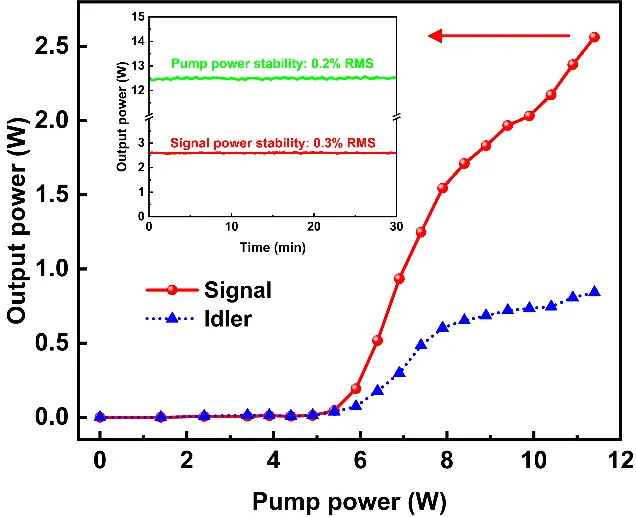
△ Graph of Output Power Curve of Periodic Crystal Array Frequency Converter
Illustration: Measurement of output power stability
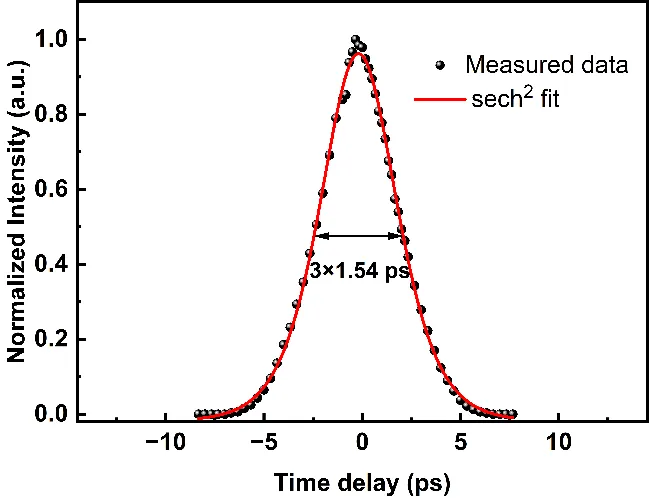
△ Self-related Method to Measure Periodic Crystal Array Frequency Converter
Output 1.5μm signal light pulse width map
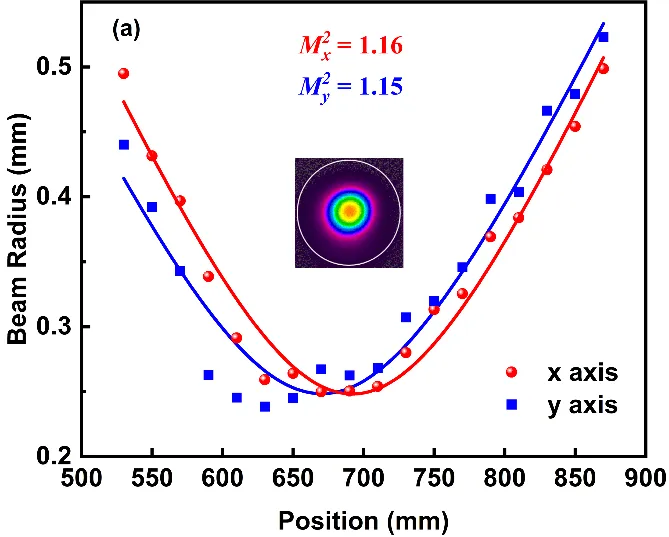
△ Curve Plot of 1.5μm Signal Light Beam Quality Fitting
Illustration: Two-dimensional spotting of signal light
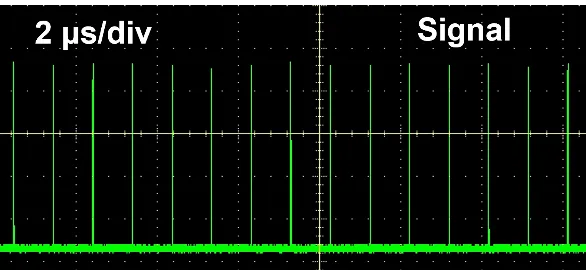
△ Repetition Sequence Diagram of 1.5μm Signal Light
Prospects for industrial application
The breakthrough significance of this outcome lies not only in the achievement of laboratory indicators, but also in its paving the way for industrialization. Its industrialization prospects are mainly reflected in two aspects.
On the one hand,the technology opens up several high-value application scenarios.
On the other hand,in late-stage productification,the technology also has the following significant advantages.
The success of this joint experiment,not only verified the feasibility of the new technology of “periodic array mode self-replication,”It also defines a new benchmark in the direction of miniaturization and high performance of ultrafast lasers, providing a new solution with engineering potential for industrial applications.
This further confirms the unique advantage of Huachuang Hongdu in the deep integration of cutting-edge scientific concepts and mature engineering capabilities.Looking ahead,Huachuang Hongdu will continue to deepen its strategic cooperation with scientific research institutions,Focus on key areas such as ultra-fast lasers and high-power lasers,and make every effort to promote the whole chain from principle innovation,technology verification to product landing and industrial promotion,so as to contribute solid force to the process of China’s high-end laser equipment autonomy and the enhancement of its global competitiveness.