Heat-free Zone, Micron-scale Precision | Summary of Ultraviolet Skin-second Laser Cutting of Different Types of Metal Sheeting
Author: Laserion Published on: 2026-04-17
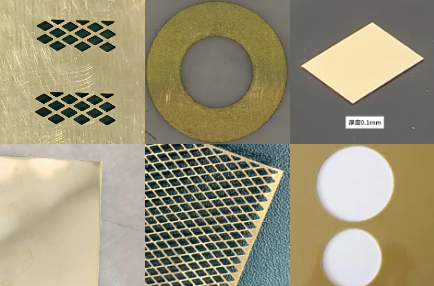
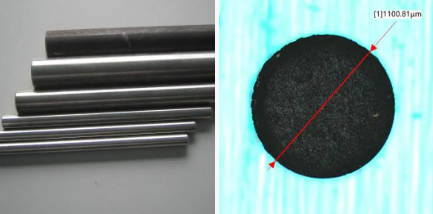
△ A Display of Metal Materials
Copper foil, gold-plated copper, aluminum alloy and other metal materials, with excellent electrical, thermal and mechanical properties, in the semiconductor, consumer electronics and many other fields play a key role. However, with the rapid development of devices in the direction of thinness and integration, the traditional metal processing technology gradually reveals its limitations in precision, efficiency and quality, and is difficult to meet the increasingly stringent processing requirements.
This issue of Process Notes focuses on the real cutting performance of ultrafast laser “cold processing” technology on different metal materials, opening up a new path for precision metal processing, and helping customers achieve greater precision, higher efficiency and better results.
01The Pain Points of Traditional Cutting Processes
Before the mature application of ultra-fast lasers, traditional metal material cutting methods have long been trapped in the following bottlenecks, making it difficult to break through the barrier of high-end manufacturing:
Traditional mold crushing: It is prone to hair spurs, edges curling and stress deformation, and it is easy to cause coating scratches, and cannot cope with the machining requirements of irregular parts.
Traditional wire cutting (EDM): Inefficient, the incision surface is rough, and the processing requires conductive contact, which is not suitable for ultra-thin materials, and it is easy to produce microcracks, which affect the strength and service life of the material.
General laser cutting (nanosecond / continuous laser): The heat has a large impact, which can easily cause the gold layer to burn, change color, even occur the edges carbonization and melt splattering, which will lead to adverse conditions such as material degeneration or micro-short circuit.
For different metal materials, the traditional methods also have personalized defects, which further limit the process upgrade of high-end manufacturing.
△Traditional Processes for Cutting Metal Pain Points
02 The Cutting Advantages of Ultrafast Laser Processing
Huachuang Hongdu uses ultraviolet picosecond ultra-short pulse laser technology to focus the laser beam precisely on the surface of metal materials. At extremely high peak power density, the material is ionized and directly vaporized in an instant, and almost no melting stage is produced. The heat is not enough to diffuse to the surrounding area before the material is cut. Compared to ordinary lasers , its advantages are particularly prominent :
The “cold processing” mechanism, with no heat impact zone: There is no obvious heat conduction in the cutting process, no carbonization and blacking on the sides of the cut, and the material base and functional layer (such as gold layer and oxide film) are kept intact, meeting the strict requirements for electrical insulation of radio frequency circuits.
Good quality on the edges, without curly edges: The cutting edge is neat and smooth , without mechanical punching common burrs and rolled edges , no microcracks left by wireless cutting , suitable for precision connectors , medical electrodes and other high-demand scenes , without subsequent grinding treatment .
Non-contact machining, no stress deformation: Non-contact machining, without molds, does not generate mechanical stress, can easily handle the 0.02mm ultra-thin foil and complex graphic cutting, such as foreign holes, fine lines, contours, etc., and has high processing flexibility.
Universal material, high cutting efficiency: It has stable processing ability for high antiferrous materials (copper, aluminum), hard brittle sheets, multi-layer heterogeneous structures, and heterogeneous wire. With the multi-pulse mode of the masher, the cutting efficiency can be improved while ensuring the quality, taking into account the yield and production capacity.
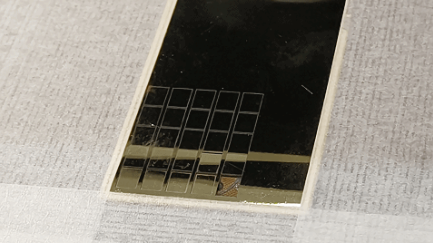
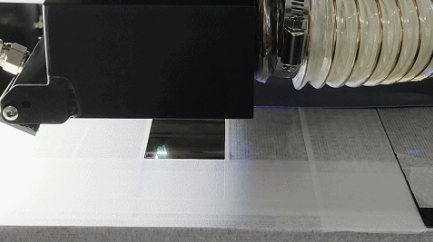
△ Demonstration of Ultraviolet Picoseconds Metal Cutting Process (Shown as Gilded Copper Flakes)
03 Shared Measurements of Cutting of Different Metal Materials
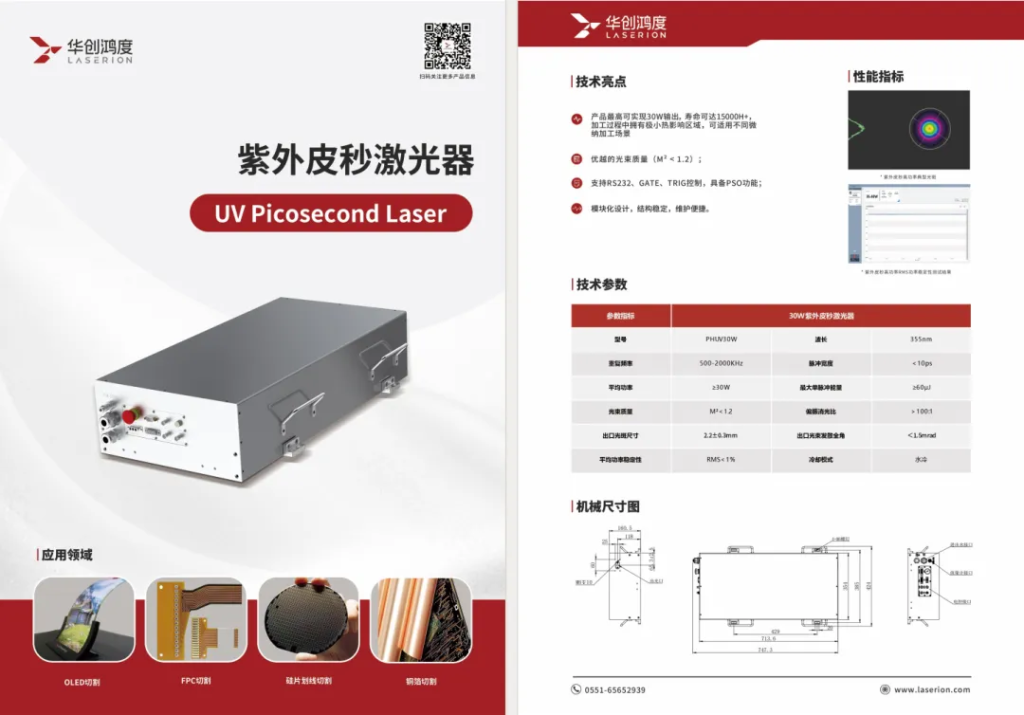
In order to comprehensively verify the actual performance of ultraviolet picosecond cutting multi-metal materials, this test uses the 30W ultraviolet picosecond laser of Huachuang Hongdu, the core parameters are: wavelength 355nm, Pulse width < 10ps, Repetition frequency 500-2000kHz.
△ 30W UV Picosecond Laser Product Specification
The test results show that: all the tested metal materials achieve high precision cutting effects with smooth edges and no burrs, no heat affected zone, and the processing level reaches the industry’s super high standard, which can be directly adapted to the actual needs of high-end manufacturing scene.
Application scenario: Flexible circuit, lithium battery current collector, electromagnetic shielding film, precision sensor and other high-end electronic devices.
Craft Interpretation:
Fine cutting at a micron scale, with neat edges without thorns and no deformation;
There is no heat impact area, maintains the electrical conductivity of the copper foil, and no oxidation discoloration.
(2) Gold-plated copper
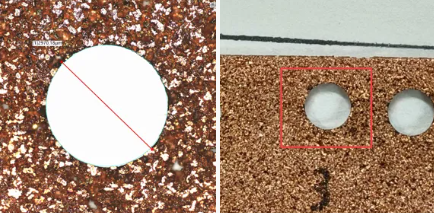
△ Cut of Gilded Copper Slices
Application scenario: High-end fields such as radio frequency circuits, precision connectors, medical electrodes, aerospace electronics and other fields.
Craft performance:
The “cold processing” mechanism inhibits heat diffusion from the source, and the gold layer is complete without burning, and there is no heat-affected area.
The seams are smooth, without thorns and without carbonization, reaching the highest level in the industry.
Easily handle complex graphic cutting, such as exotic pores, fine lines, contours, etc.
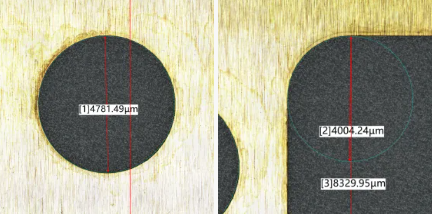
For rectangular, circular and asymmetrical intersection lines, high-quality contactless cutting and precision opening of windows;
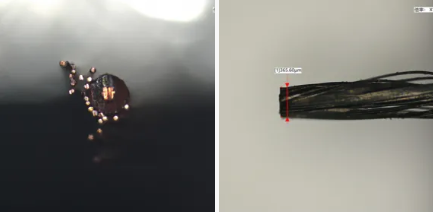
There are no spikes and no heat impact areas, and the end surface is flat to maintain the electrical conductivity and mechanical strength of the wire.
It can process extremely fine metal wire (copper, gold, platinum, iridium, etc.) to meet the requirements of high reliability electronic manufacturing.
(6) Stainless steel
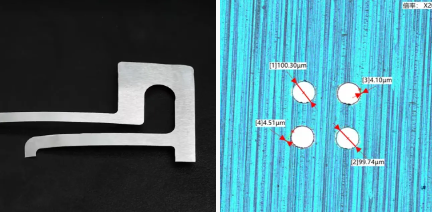
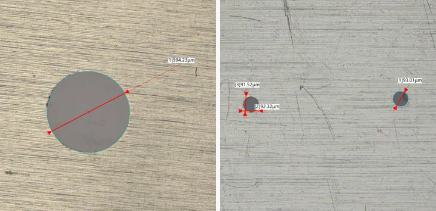
△ Stainless Steel Cutting
Application scenario: Industries, construction, home decoration, food and medical industries, etc.
Craft performance:
The minimum can realize 0.1mm stainless steel precision drilling and cutting;
The edges are smooth, without thorns, without slag, and no secondary grinding is required;
There is no heat affect area, no oxidation discoloration of the cutting edge, and the corrosion resistance of stainless steel is preserved.
Technical Preview
In the coming installments of the “Process Notes” series, we will continue to explore the limitless possibilities of laser processing on a variety of different materials, and you are welcome to stay tuned.